Key Takeaways:
- Know your actual production cost per print before setting any price.
- Price your transfers according to size and ink coverage, not a flat rate. Bigger designs and heavier coverage use more material and should cost more.
- Hidden costs (machine wear, wasted prints, labor time) are what quietly kill margins. Consider them while setting prices.
- Use a pricing calculator to remove guesswork. It’s useful especially when you’re pricing multiple sizes, quantities, and tiers regularly.
How to Price Your DTF Transfers?
The simplest way to price DTF transfers profitably is to start with your actual production cost per transfer. Once you know what you’re spending on ink, film, powder, labor, equipment, and other production expenses, you can set prices based on real numbers instead of assumptions.
If you’re underpricing your DTF transfers, you’re not building customer loyalty, you’re funding someone else’s print shop. Also, overpricing isn’t the answer either.
Pricing is one of the most important factors of any business, yet many shop owners still price their transfers based on guesswork. Not because they’re bad at math, but because they don’t have a clear picture of what each transfer actually costs them.
When you understand your true costs, you can stop guessing and price your DTF transfers with confidence.
Understanding the Real Cost of DTF Printing
“How much should I charge for a DTF transfer?” Before anyone answers this, you need to understand what a transfer actually costs you to produce.
Most print shop owners make mistakes at this point; they set prices according to what competitors charge or what feels fair without ever calculating their own cost per print.
The real cost of DTF printing includes far more than ink and film. It includes your machine’s depreciation, your time, your shop/workspace cost, and the inevitable waste that comes with any print run.
Why Does Pricing Matter?
Pricing isn’t just about making a sale and earning profit for a specific time period. It also determines whether your business succeeds or struggles in the long run.
Here’s what your pricing affects:
- Cash flow: If your transfers are underpriced, you might struggle to pay for ink, film, powder, and other supplies.
- Sustainability: If transfer prices only cover your costs, you won’t have extra money for repairs, slow months, or business growth.
- Perceived value: very low prices can make customers think your transfers are low quality.
- Scalability restriction: If you barely make money on each order, it becomes harder to hire help, buy better equipment, or handle bigger orders.
If you get pricing right, everything else in the business gets easier. Get it wrong, and you’ll be busy without ever being profitable.
How Much Should I Sell My DTF Prints For?
There’s no fixed formula or number for it. It depends on your transfer size and material costs. However, once you calculate all your real costs, most shops fall within these general price ranges:
- Small designs (under 5″x5″): often priced per print with a modest per-unit margin.
- Standard sizes (10″x12″ and similar): priced to reflect higher ink and film usage.
- Oversized or full-back prints: priced highest due to material use and handling time.
The exact number matters less than the method. If you calculate your real cost per print and apply a consistent margin, your prices will always be profitable regardless of size.
Factors That Actually Control DTF Transfer Price
Several factors directly affect the pricing strategy you set for DTF transfers. Understanding these factors helps you set a price that covers your costs while still giving you a healthy profit.
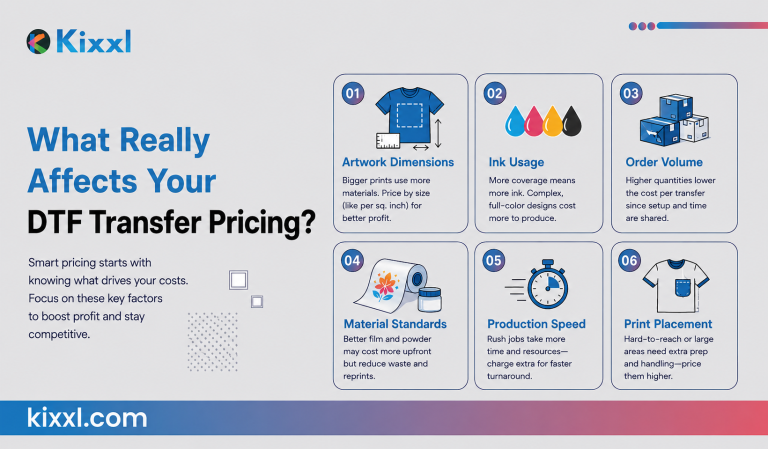
- Design size: since bigger designs use more film, ink, and powder, they should cost more. For example charging Price per square inch would be more profitable instead of flat rate per design.
- Ink coverage: a solid, full-color design uses significantly more ink than a simple one-color logo so your price should reflect that.
- Order quantity: bulk orders usually cost less per transfer because setup and machine time are spread across more prints.
- Film and powder quality: using premium consumables cost more initially but reduce waste and reprints, which affects your overall cost per print.
- Turnaround time: Rush orders should cost more because they require faster work plus adds pressure on your equipment.
- Placement and pretreatment needs: sleeves, pockets, and oversized placements often take more handling time than a standard front print so pricing should be accordingly.
If you’re not adjusting your price based on these factors, you’re pricing blind.
Hidden Costs That Most Shop Owners Forget to Include:
This is where most shops quietly lose money. It’s easy to sell your DTF transfers according to ink and film prices. It’s much easier to forget the costs that don’t show up on a receipt.
- Machine depreciation: your printer and heat press won’t last forever. Every print should carry a small portion to cover future repairs or replacement.
- Electricity Cost: DTF printers and curing machines use electricity every time they run, which is a significant monthly cost.
- Wasted prints: misfires, color mismatches, and film jams happen. Budget for a realistic waste percentage, not zero.
- Labor time: Your time spent preparing files, printing, checking, packing, and handling orders also has a cost.
- Software and design tool subscriptions: RIP software, design tools, and other subscriptions are ongoing expenses that should be included in your pricing.
- Shipping supplies and packaging: Mailers, sheets, tubes, boxes, and other packaging materials also add to your overall cost.
If you don’t include these costs, you may think you’re making a profit when you’re not.
How to Price DTF Transfers: The Simplest Formula for Profitable DTF Pricing
Here’s a simple way to calculate your price per print that works in both situations; slow times and as your business grows.
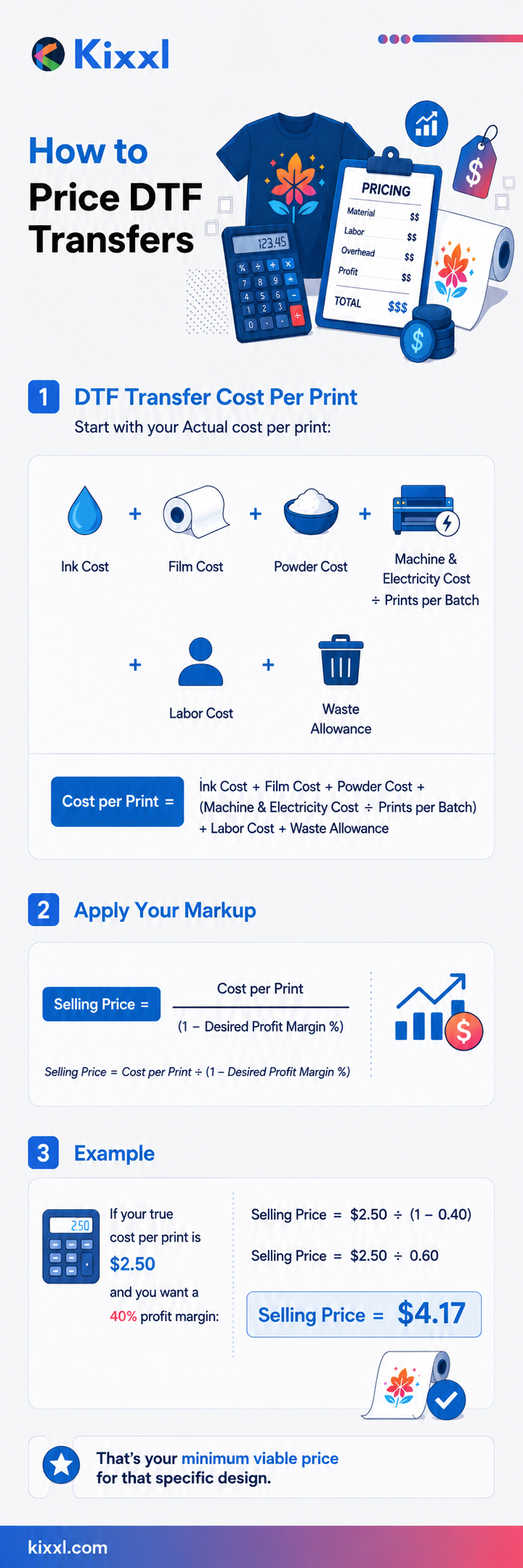
Cost Per Print:
Cost per Print = Ink Cost + Film Cost + Powder Cost + (Machine & Electricity Cost ÷ Prints per Batch) + Labor Cost + Waste Allowance
Once you have that number, apply your markup:
Selling Price = Cost per Print ÷ (1 − Desired Profit Margin %)
For example, if your true cost per print is $2.50 and you want a 40% profit margin:
Selling Price = $2.50 ÷ (1 − 0.40) = $2.50 ÷ 0.60 = $4.17
That’s your minimum viable price for that specific design.
Use a Free DTF Pricing Calculator
Calculating the cost manually for every design, order, and size can take a lot of time. Also, small mistakes can also reduce your profit over time. A free DTF pricing calculator makes this easier. Enter your costs once, and it can quickly calculate the right price based on size, quantity, ink, film, and machine time.
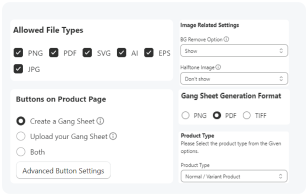
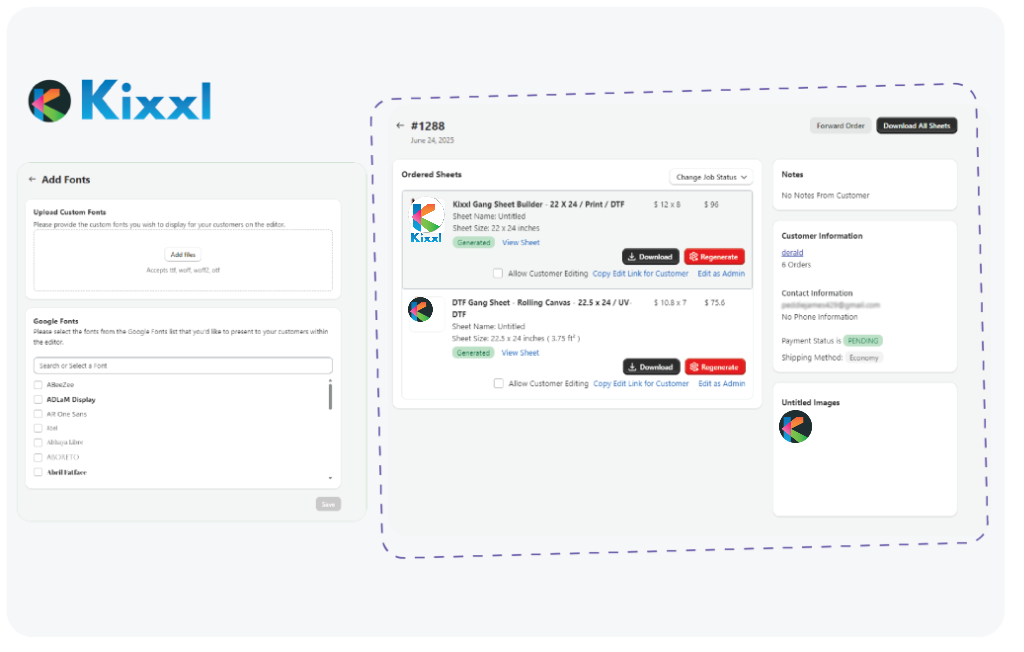
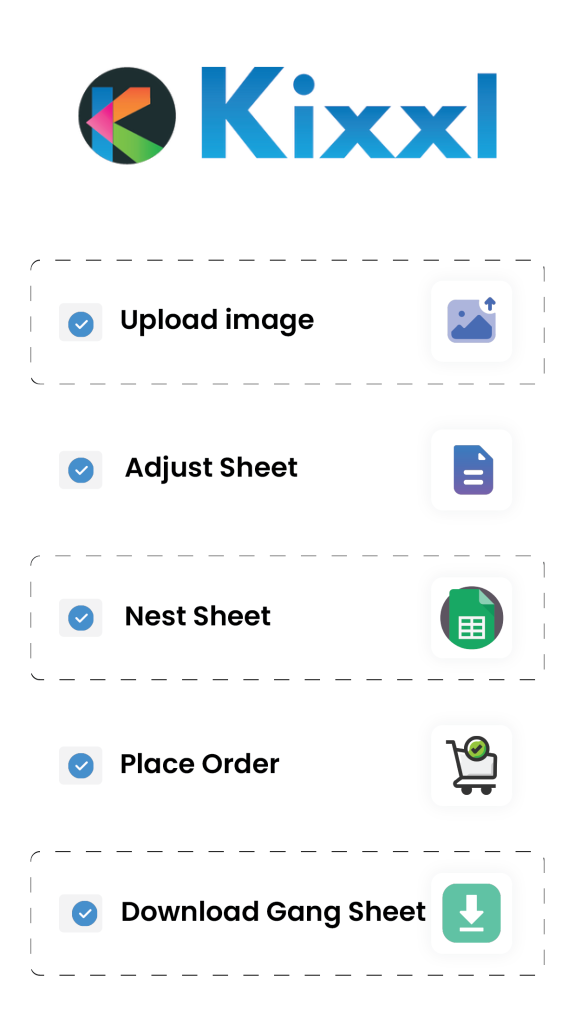
If you’re already using tools like Kixxl to build and manage your DTF gang sheets, pricing is built directly into the workflow, so you’re not pricing separately from production. You calculate cost, generate the sheet, and price it all in one place
How to Sell DTF Transfers at This Price?
Once your numbers are solid, selling becomes easier because you’re pricing with confidence, not guessing:
- Offer tiered pricing by quantity (1–10, 11–50, 51+) so bulk buyers get a fair rate without you losing margin.
- Set a minimum order value to avoid tiny orders that aren’t worth the setup time.
- Separate retail and wholesale price sheets clearly, so resellers know what to expect.
- Bundle rush fees and oversized print fees as add-ons instead of baking them into your base price
Mistakes You Should Avoid While Pricing DTF Transfers
Even experienced shop owners fall into these traps:
- Copying competitor pricing without knowing their cost structure. Their price might be low according to their actual cost.
- Charging a flat rate regardless of size, which means large designs quietly bleed profit.
- Forget to update prices after cost increases of ink, film, and shipping.
- Using the same price for both retail and wholesale. Both customers need different pricing. Otherwise, you may lose bulk buyers or make less profit on small orders.
- Not including your work hours in the cost instead of treating your time as free.
Fixing even two or three of these mistakes can meaningfully change your monthly profit without raising a single price.
Final Thoughts
Pricing DTF transfers isn’t about picking a number that sounds fair. It’s about knowing your real costs, keeping in view the hidden factors and applying a consistent formula every time. Do that, and pricing stops being a guessing game and starts being one of the most reliable profit levers in your shop.
Calculate your cost per print correctly once, and pricing every future order becomes easy and predictable.