Key Takeaways
- The Best DTF Printer depends on your business’s daily volume, available space, budget, print size, and how much automation you need.
- Entry-level and compact machines such as the Procolored K13 and DTF Station Prestige R2 Pro can make sense for startups and growing shops.
- Production machines such as the Roland TY-300i, Mimaki TxF300-75, and DTF Station Prestige XL2 are designed for substantially higher throughput.
- Printer speed isn’t the same as business capacity. Your real output also depends on film handling, powder application, curing, cutting, heat pressing, maintenance, and artwork preparation.
- A reliable DTF workflow matters as much as the printer. White-ink management, RIP software, maintenance, film width, and automation of repetitive jobs all affect profitability.
Top 10 DTF Printers For Custom Apparel in 2026
Here are the top DTF printers for custom apparel in 2026, from small shops to high-volume production but they differ mainly in print width, speed, automation, and what they need to run.
- Epson SureColor F1070
- Roland BY-20
- Roland TY-300i
- Mimaki TxF300-75
- Brother GTXpro
- DTF Station Prestige R2 Pro
- DTF Station Prestige XL2
- Procolored K13
- RICOH Pro D1600, and
- DTF Station Prestige X6.
But choosing a printer shouldn’t start with the question “Which machine has the highest DPI?” The better question is: Which printer can handle the type and volume of work my apparel business actually receives?
That’s what this blog focuses on.
The Best DTF Printers: A Quick Comparison
Here is a quick comparison of top 10 DTF printers. However, the mentioned printer speeds are not directly comparable across brands because manufacturers use different print modes, resolutions and test conditions. Consider them as specifications rather than guaranteed shirt-per-hour output.
Printer | Print width | Published max/production speed | Printheads | Best suited for |
Epson SureColor F1070 | Apparel platen / DTFilm system | Varies by mode | PrecisionCore Micro TFP | Small businesses wanting DTG + DTF |
Roland BY-20 | 18.9″ print/cut width | Varies by mode | Piezo | Compact shops & DTF + cutting |
Roland TY-300i | 28.9″ | Up to 12.3 m²/h on current product page | Piezo | Commercial DTF production |
Mimaki TxF300-75 | 31.5″ | Production-class; up to 300% productivity vs. predecessor | 2 staggered piezo heads | Professional apparel production |
Brother GTXpro | Up to 16″ × 21″ platen | Varies by configuration | 2 Brother piezo heads | DTG/DTF hybrid shops |
Prestige R2 Pro | 13″ | 30–35 ft²/hr | 2 × Epson i1600 | Growing small/mid-size shops |
Prestige XL2 | 24″ | Up to 82.9 ft²/hr | 2 × Epson i3200 | Production floors |
Procolored K13 | 13″ | A4/Letter in about 10 min | LH-600 | Small shops/startups |
RICOH Pro D1600 | Up to 51.2″ media | Up to 20 m²/h | 3 × Ricoh MH5441 | Large-scale textile production |
Prestige X6 | 36″ | Up to 310 ft²/hr | 6 × Epson i3200-A1 | Very high-volume production |
Important:
- Speed figures are manufacturer-published figures and can vary substantially with resolution, pass count, artwork, white-ink coverage, media and production conditions. Epson’s F1070, for example, is positioned as a hybrid DTG/DTFilm machine rather than a dedicated roll-to-roll DTF printer.
Which DTF Printer Is Best for a Small Custom Apparel Business?
1. Epson SureColor F1070
The Epson SureColor F1070 is an interesting option if you don’t want your business locked into DTF alone.
It is a hybrid DTG/DTFilm printer, meaning you can print directly onto garments as well as use film-transfer workflows. Epson positions the F1070 as a compact machine designed for apparel businesses and makers, with a PrecisionCore Micro TFP printhead, nozzle verification technology and UltraChrome DG2 ink.
Why Consider It?
- Compact compared with larger production systems
- Supports both DTG and DTFilm
- Useful if you sell different types of apparel
- Automatic garment-height adjustment
- 4.3-inch touchscreen
- Epson Garment Creator 2 software
- Cloud production monitoring is available
The F1070 also uses a cartridge-free ink-pack system and is designed around Epson’s own ink system.
Best for: Small-to-medium apparel businesses that want both DTG and DTF/DTFilm capability.
Potential limitation: If your entire business is based on high-volume roll-to-roll DTF gang sheets, a dedicated production DTF printer may be a better fit.
2. Roland VersaSTUDIO BY-20
It is a compact DTF printer that also includes contour-cutting capability, making it useful when you want to produce DTF transfers and cut heat-transfer graphics from the same device. Roland lists a maximum print/cut width of 18.89 inches, a maximum resolution of 1,440 dpi, and CMYK + white ink.
The machine weighs about 62 kg and is approximately 42.1 × 24.3 × 24.5 inches. That makes it considerably more compact than many production-floor machines.
Why is the built-in cutter interesting?
Suppose your apparel business sells:
- DTF transfers
- Heat-transfer graphics
- Custom logos
- Small apparel graphics
The BY-20 can cover more than one workflow.
Best for: Small businesses that value space efficiency and the combination of DTF printing and cutting.
Potential limitation: Its smaller media width makes it less appropriate when your main business requires large-volume, wide gang-sheet production.
3. Roland TY-300i
The Roland TY-300i sits much further up the production scale.
Roland describes it as a DTF printer built for continuous, commercial-grade production, with a maximum print width of 736 mm (28.9 inches). The machine uses CMYK + white S-PG3 ink and supports production modes up to 12.3 m²/h on Roland’s current product page.
The TY-300i is designed to work as part of a broader DTF system, including an optional shaker/dryer.
One particularly useful feature for production environments is its four white-ink channels, which allow cartridges to be replaced during a run and are designed to reduce interruptions.
Roland also claims:
- Up to 2× faster production than tested competitors
- Approximately 1.6× wider color gamut with its new ink
- Up to 40% lower running costs under its stated comparison conditions
These are Roland’s internal test claims, so they should not be treated as universal industry benchmarks.
Best for: Established apparel businesses that need reliable, continuous DTF production.
Potential limitation: This is a substantial production investment and may be unnecessary for a shop doing only a few dozen shirts per week.
4. Mimaki TxF300-75
Mimaki’s TxF300-75 is designed for professional DTF production with a maximum printing width of 800 mm (31.5 inches).
It uses two staggered piezo printheads and supports 720, 1,080 and 1,440 dpi printing. It uses PHT50 heat-transfer pigment ink in CMYK + white, with white-ink circulation.
Mimaki says the TxF300-75 offers approximately 300% productivity compared with its TxF150-75 predecessor, under its specified test conditions.
- Why does white-ink management matter?
White ink management is one of the crucial factors that’s responsible for accurate color output in DTF printing. White pigment can settle when it isn’t properly circulated. Poor white-ink management can contribute to:
- Nozzle problems
- Uneven white underbases
- Banding
- Color inconsistency
- Wasted film
- Maintenance downtime
Mimaki incorporates its NCU and NRS technologies to detect nozzle issues and help recover from nozzle problems during production.
Best for: Print shops looking for a professional, production-oriented DTF platform with strong emphasis on stability.
5. Brother GTXpro
The Brother GTXpro is another hybrid option.
Brother’s industrial printing division lists GTXpro and GTXpro B as DTG/DTF hybrid solutions. The GTX platform can also be paired with Brother’s roll-to-roll DTF solution for higher-volume transfer production.
The GTXpro has:
- Two Brother piezo printheads
- Eight ink channels
- Up to 1,200 × 1,200 dpi resolution
- Maximum print area of 16 × 21 inches
- Water-based pigment ink
Brother also documents a dedicated DTF workflow for GTXpro, including DTF film and powder, a heat press and optional curing equipment.
- Why might a hybrid printer make sense?
Imagine your shop handles: “Direct-to-garment orders + DTF transfers + specialty placements”
A hybrid platform gives you more flexibility than purchasing separate machines immediately.
Best for: Established apparel businesses that want DTG and DTF capability from the same printer ecosystem.
Potential limitation: If DTF is overwhelmingly your core production method, compare its DTF workflow against dedicated roll-to-roll machines rather than evaluating it only as a DTG printer.
6. DTF Station Prestige R2 Pro
The Prestige R2 Pro is designed for businesses that have outgrown an entry-level desktop printer but don’t yet need a large production-floor system.
It has:
- 13-inch print width
- Two Epson i1600 printheads
- CMYK + double white
- White-ink circulation
- Built-in cutter
- Roll-to-roll operation
- Published speed of 30–35 ft²/hour at production-level resolution
DTF Station currently positions it for intermediate users and gives a daily-output example of approximately 180 pieces based on a 12 × 14-inch design and an eight-hour day.
That’s an important distinction: 13-inch doesn’t automatically mean “hobby printer.”
A compact printer can still be useful for a serious apparel business if its production volume matches the business.
Best for: Growing shops that need more throughput but have limited floor space.
7. DTF Station Prestige XL2
The Prestige XL2 is a 24-inch production DTF printer. Its current published specifications include:
- 24-inch print width
- Two Epson i3200 printheads
- CMYK + four white channels
- Up to 82.9 ft²/hour
- Up to 2,880 dpi
- White-ink circulation
- Auto-wet capping
- Head-strike sensor
DTF Station describes it as a machine intended to move onto the production floor and lists an example capacity of 521 shirts/day. The manufacturer also offers matching 24-inch shaker/dryer equipment, which matters because a DTF printer shouldn’t be evaluated in isolation.
Best for: Shops producing significant daily volume and using gang sheets regularly.
- Why is 24-inch width important?
A wider printer lets you arrange more artwork across a single film run.
For example, instead of printing One 12 × 14-inch design, you may be able to arrange multiple designs across a wider sheet. This is where gang-sheet optimization becomes important. The printer’s width is only valuable if you’re actually using that space efficiently.
8. Procolored K13
The Procolored K13 is a compact 13-inch DTF printer aimed at smaller operations. Its current published specifications include:
- 13-inch print width
- LH-600 printhead
- CMYK + double white
- 1,440 × 1,440 dpi, 8-pass mode
- About 10 minutes for a Letter/A4 print
- Approximately 6 pieces/hour based on Procolored’s listed Letter/A4 test
- 18 kg printer weight
This is a very different category from machines such as the Roland TY-300i or Mimaki TxF300-75. If you are a startup, you don’t necessarily need an industrial printer.
Who should consider it?
It can make sense if you’re:
- Starting a custom T-shirt business
- Testing market demand
- Running a home studio
- Producing relatively small quantities
- Working with limited floor space
Best for: Beginners and small businesses where production volume is still relatively low.
Potential limitation: If you’re already processing hundreds of garments regularly, a 13-inch desktop-class machine may quickly become a bottleneck.
9. RICOH Pro D1600
The RICOH Pro D1600 moves into a much wider production category.
Ricoh announced the system for industrial textile printing with a maximum film width of 1,300 mm and a published maximum printing speed of 20 m²/hour. It uses three Ricoh MH5441 inkjet heads and supports resolutions up to 1,200 dpi.
Ricoh positions the system toward:
- Screen-printing businesses moving into digital
- Medium-to-large textile printers
- High-volume textile production
The printer supports DTF transfers for materials including:
- Cotton
- Polyester
- Blends
- Nylon
- Leather
Best for: Large apparel/textile operations where production scale justifies a wide-format DTF system.
Potential limitation: This is far beyond what a typical startup or small Shopify apparel seller needs.
10. DTF Station Prestige X6
At the top end of this comparison is the Prestige X6 having:
- 36-inch print width
- Six Epson i3200-A1 printheads
- CMYK + LcLmGO + four white channels
- Up to 310 ft²/hour
- 36-inch film width
This is not a machine you buy because you’re “starting a T-shirt business.” It’s designed for a production environment where output is the constraint.
If you’re already receiving enough orders to keep a 36-inch production line busy, the additional throughput can make sense.
Best for: High-volume DTF production facilities and businesses serving large apparel orders or wholesale customers.
How Should You Choose Between a 13-inch, 24-inch, and 36-inch DTF printer?
Printer width is one of the most important decisions you’ll make.
13-inch systems
Examples:
- Procolored K13
- Prestige R2 Pro
Best when:
- You’re starting out
- Orders are relatively small
- Space is limited
- You’re testing demand
- Most designs are standard apparel sizes
24-inch systems
Examples:
- Prestige XL2
Best when:
- You’re printing regular gang sheets
- Order volume is growing
- You’re serving wholesale customers
- You need better production efficiency
30–36-inch systems
Examples:
- Roland TY-300i
- Prestige X6
- RICOH Pro D1600
Best when:
- DTF is a major production operation
- You have consistent high-volume orders
- You’re running multiple heat presses
- Labor and production efficiency matter more than machine footprint
The mistake is buying the widest machine you can afford instead of the widest machine you can keep productive.
How Much Does DTF Printer Speed Actually Matter?
Speed matters, but it’s easy to misunderstand it.
Suppose Printer A can print 80 ft²/hour while Printer B prints 40 ft²/hour. That does not necessarily mean Printer A doubles your finished-shirt production.
Why? Because DTF production includes several stages:
Artwork preparation
↓
Gang-sheet layout
↓
Printing
↓
Powder application
↓
Curing
↓
Cutting
↓
Heat pressing
↓
Quality control
↓
Packing
If your printer can produce 80 ft²/hour but your powder shaker can process only 40 ft²/hour, your printer is not actually doubling your finished output.
The bottleneck simply moves downstream.
Why shouldn't you choose a DTF printer based only on DPI?
A common mistake is assuming: Higher DPI = better printer.
Not necessarily. Your finished transfer depends on much more than resolution. Alongside DPI, you should consider:
- Printhead technology
- Ink quality
- RIP settings
- White-ink density
- Color management
- Film
- Powder
- Curing
- Press temperature
- Press pressure
- Press time
- Garment composition
A printer running at 1,440 dpi isn’t automatically going to produce a better shirt than a machine running at 1,200 dpi.
In fact, a stable printer producing consistent results at a practical production setting can be much more valuable than a printer capable of extremely high resolution that requires excessive maintenance.
Why Does Gang-sheet Optimization Matter for Custom Apparel?
If you’re printing many small designs, the goal isn’t simply to print one design after another. You want to use the available film area efficiently.
Imagine you have orders for:
- 10 small chest logos
- 20 sleeve prints
- 15 names
- 10 large front prints
Printing each separately could waste a significant amount of film. An optimized gang sheet layout can combine many designs into one production run. The bigger the printer, the more important the efficient layout becomes.
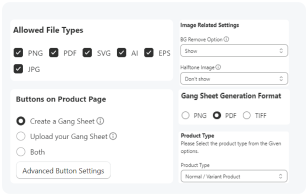
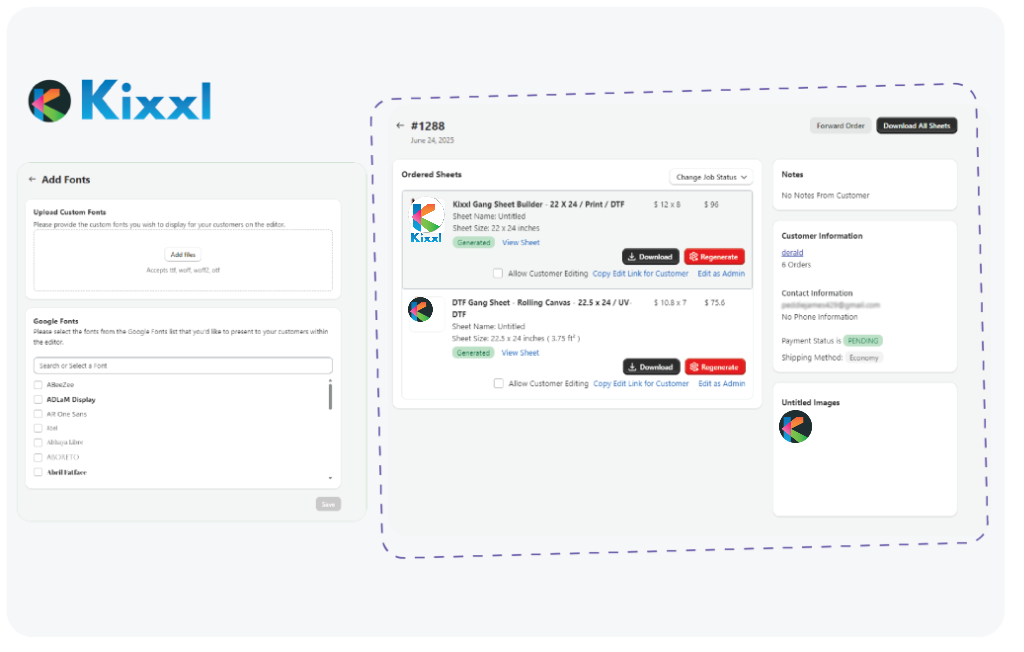
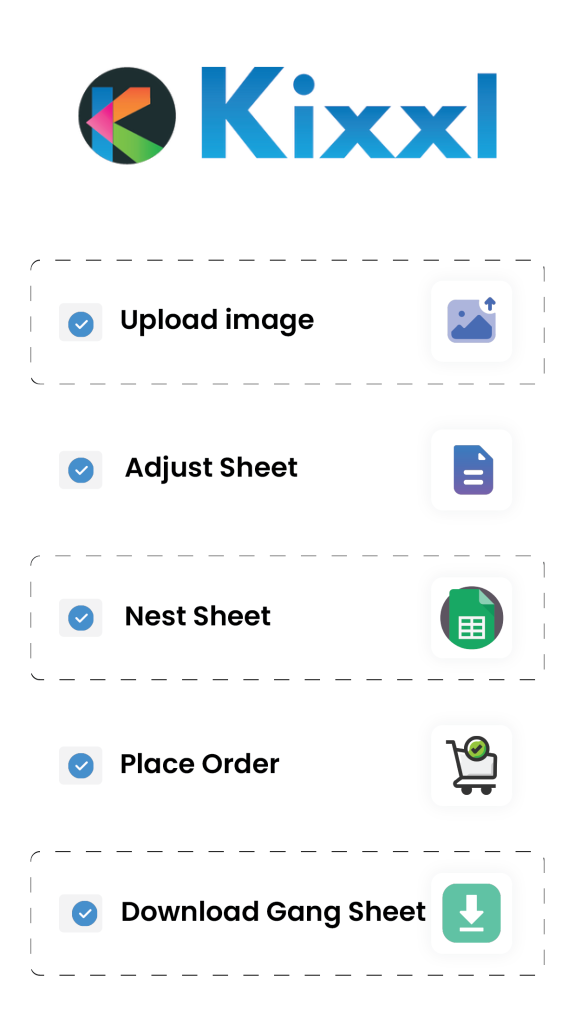
This is one reason DTF shops often benefit from automated nesting and gang sheet building software alongside the printer.
What Should You Check Before Buying a DTF Printer?
If possible, send your own artwork to the dealer for a live demonstration. Don’t rely only on the manufacturer’s sample images.
Prepare a test file containing:
- Small text
- Fine lines
- Gradients
- Skin tones
- Bright colors
- Dark artwork
- Transparent areas
- White artwork
- Photographic details
- Large solid-color areas
Then ask the dealer to print it using the normal production workflow. Afterward, test the transfer on the actual garments you sell.
Also, Don’t stop at the first print
Wash the printed garment. Check:
- Color retention
- Cracking
- Peeling
- Stretching
- Edge quality
- White underbase
- Hand feel
A beautiful transfer straight off the press doesn’t necessarily mean it will perform well after repeated washing.
Some Common Mistakes When Buying a DTF Printer
- Buying based on the lowest price
A low initial price can hide higher maintenance and operating costs.
- Buying too much printer
A 36-inch industrial system doesn’t make sense if you’re selling 10 shirts per day.
- Ignoring the shaker and dryer
A fast printer paired with a slow curing workflow becomes a bottleneck.
- Ignoring service availability
A printer is not useful when it’s sitting idle because there is no technician or replacement part nearby.
- Comparing DPI instead of output quality
Higher resolution numbers don’t automatically equal better transfers.
- Not testing your own artwork
Manufacturer samples are useful, but your customers won’t necessarily send manufacturer-friendly artwork.
- Forgetting white ink
White-ink stability should be one of the first questions you ask.
- Ignoring artwork preparation
A fast printer won’t fix poorly prepared files.
- Not planning for growth
Buying a machine that perfectly matches today’s volume may become a bottleneck six months later.
What is the best DTF printer for custom apparel overall?
There isn’t one universal winner, but the shortlist becomes much easier when you match the machine to the business.
Business Situation | Suitable Options |
Startup / low volume | Procolored K13 |
DTG + DTF flexibility | Epson SureColor F1070 |
Compact growing shop | DTF Station Prestige R2 Pro |
Compact DTF + cutting | Roland BY-20 |
Professional production | Mimaki TxF300-75 |
Commercial DTF production | Roland TY-300i |
24-inch production | DTF Station Prestige XL2 |
Large textile production | RICOH Pro D1600 |
Very high-volume DTF | DTF Station Prestige X6 |
DTG/DTF production ecosystem | Brother GTXpro |
Final Verdict
- The best DTF printer for custom apparel isn’t necessarily the fastest or most expensive machine. It’s about which printer suits the business workflow better, processes more orders with less waste, less manual work, offers consistent quality, and fewer production interruptions.
- Moreover, a reliable printer paired with efficient artwork preparation, automated gang-sheet layout and a well-organized heat-press workflow can often be more valuable than simply buying the machine with the highest advertised speed.
That is the standard you should use when comparing DTF printers in 2026.